
Rowan or Mountain Ash
Flying trees

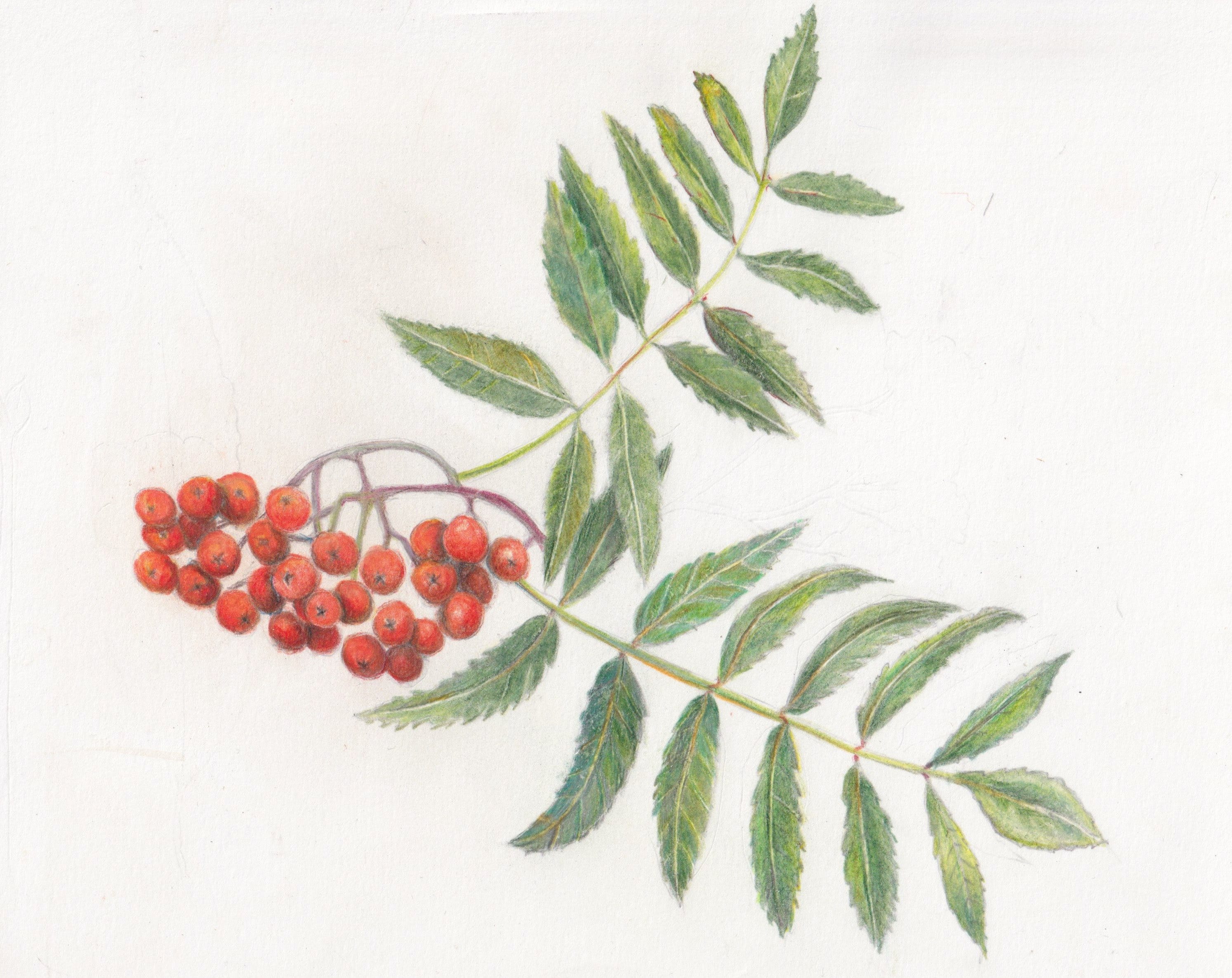
A friend recently asked why I had not included the Mountain Ash variety in an earlier post about the Ash tree. I explained, somewhat smugly, that this was because the Ash and the Mountain Ash/Rowan are trees classified under different genera. The latter is of the genus fraxinus, which is the same family as olives, whereas the Mountain Ash is of the sorbus, which is the same as the rose family. The main differences are that Ash flowers are small and dark purple, while Rowan flowers are white, and that the former produce seed in the form of winged 'keys', whereas the latter produce red berries.
I had always cursed the use of Latin names, but now, with plants, this approach starts to make some kind of sense. I’m even attempting to memorise botanical names with the help of a book; one that promises to bestow the reader with a full understanding of botanical science in a single day. So far, it has taken me three months. Admittedly, I have only looked at the first page, experienced a strong sense of dread, and retuned it to the bookshelf.
The Rowan tree has a smooth, grey, shiny bark, frothy white blossoms from May to June, along with clusters of berries and elliptical leaflets
There is a road near me that is lined with Rowan trees. I walked down this road today. The sunlight was segmented by the many leaflets above me, resembling crochet against the blue sky. Hundreds of red berries stood out in vivid contrast to the deep green of the leaves.
Rowan is the name of my nephew, so when I think of the tree, I think of him.
I’d always considered the Rowan to be an innocent, delicate tree. It is small and pretty, and lines the sides of city roads like summer fete decorations. This being the case, I was surprised to learn that this dainty looking tree is actually very tough and hardy. It can thrive in desolate conditions, such as remote mountainsides or in a cleft of a rock. This is why, despite the wispy elegance of its leaflets, the Rowan is also known as the Mountain Ash. It can even grow within another tree. When it is found growing in such locations it is referred to as a flying tree and was seen as especially magical.
In folklore the Rowan is said to provide strength, protection and the ability to win against the odds. It is also linked to poetry, prophecy and inspiration. Rowan wood was often used in divining for metals and obtaining otherworldly knowledge. For example, ancient Druids would burn Rowan wood in order to receive spirit messages before a battle. It has been known as the tree for driving out evil witches, but was also frequently used in spells and rituals.
An Icelandic myth tells of Rowan trees growing by the graves of those poor souls who had been wrongfully executed. It was said that, if a plank of wood from one of these Rowans should be used in the building of a ship, then the vessel would sink. Furthermore, if a twig from one was burned in the hearth, it would cause an estrangement between those who sat around it.
Rowan seeds are poisonous to children, although their berries are very high in vitamin C and were once taken to prevent scurvy. The juice of the berry can be gargled to soothe a sore throat. Rowan jelly is good with meat and cheese, while jam made with rowan berries and apples is said to ease diarrhoea. Rowan berry wine is an old recipe, and particularly effective in raising the spirits.
In Celtic mythology, it is ruled by the Sun and is connected to the god Lugh. It is also sacred to the Celtic goddess Bridged, who carries three fiery arrows made of its wood. In Celtic myth, the first woman was born of a Rowan tree (the first male being born of Ash). In Norse myth, it was the Rowan tree that bent low and saved Thor when he fell into a river. In Finnish myth, the Goddess Rauni gave birth to the plants of the earth whilst in the form of a rowan tree... after having made love to Ukko, the god of thunder!
It was once thought very auspicious to have a Rowan tree growing near to where you live. It’s wood can be used in the form of pins to seal your front door and prevent bad luck from entering the house. An equal-armed cross made of Rowan and tied with red thread was an ancient protection charm: hung over doorframes, it was thought to protect against faeries and other such evil. If sown into clothing, it was believed to stop the wearer being faerie-led (lost, tricked or tempted astray). Indeed, Rowan walking sticks were thought to provide safe passage through the faerie realm.
I’ve made myself a Rowan wood cross for a protection charm. As a child, I was always told to “stop being so away with the fairies”, and I still hallucinate frequently now, so perhaps the charm will root me more securely in this world. Even now I feel the presence of the unmentionables, and require protection from their more mischievous moods and ongoing desire to steal me away.
I have v small rowan in my garden and it currently has berries which is very pleasing. I have to admit i get confused how to pronounce it: row as in boat or row as in a loud noise!